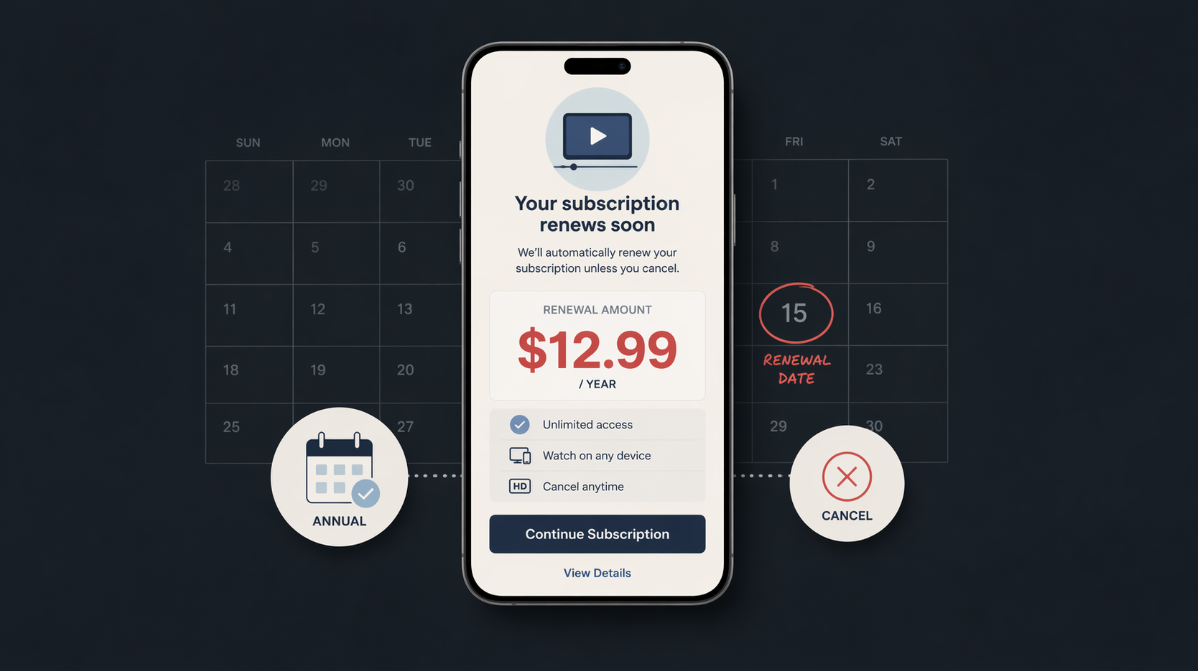
The monthly plan does not feel that different at checkout. The Apple TV subscription went from $9.99 to $12.99 in August 2025, and $3 a month reads like loose change. Stretched over a full year, that $3 turns into $36 more for the same subscription. That is where the quiet math starts working against you.
Quick answer: Apple TV, formerly Apple TV+, now costs $12.99 a month. The annual plan saves about $56 if you keep it for a full year, but that only makes sense if Apple TV is a year-round service for you. If you only come back for a few shows, canceling between releases can cost less overall.
What changed
The monthly price went from $9.99 to $12.99 in August 2025. Existing monthly subscribers didn’t see the new rate until 30 days after their next renewal, so the timing depended on each billing cycle. By April 2026, most monthly subscribers have likely already seen the higher price.
What Apple didn’t touch matters just as much. The annual plan is still $99.99. Apple One Individual is still $19.95. Apple One Family is still $25.95. That wasn’t an accident. Apple raised one price and left every other path open.
Where the math flips
Twelve months at $12.99 comes out to $155.88. The annual plan is $99.99. The gap, about $56, is the number most coverage stops at.
But that only matters if you actually stay subscribed for twelve months. The annual plan works out to roughly $8 a month, which is cheaper than the original $9.99 price from before the hike. If you subscribe for less than eight months in a year, paying monthly and canceling during the gaps ends up costing less than buying the annual plan upfront.
That’s the question you actually need to answer. Not “is $99.99 cheaper than $155.88.” It always is. It’s whether you’re a year-round Apple TV viewer or a show-by-show one.
Who should switch to annual
Annual makes more sense if Apple TV has become a sports subscription for you, not just a place you visit for one drama every few months. Apple now streams every MLS regular season match and every F1 Grand Prix in the U.S. MLS runs February through December. F1 is a nearly year-round calendar. If either of those is on your watch list, you’re already past the eight-month break-even without thinking about it.
The same logic applies to households where Apple TV is effectively always on. A kid watching Snoopy in Space, a partner working through Severance, and you on your third Ted Lasso rewatch means the service is running whether you track it or not. Family Sharing makes this the default for a lot of households.
If any of this sounds like you, switch at your next renewal. About $56 a year back, and one fewer recurring charge to keep track of.
Who should cancel instead
There’s a pattern Apple would rather you not think about. You signed up when Severance Season 2 dropped. Watched every episode. Meant to cancel. Didn’t. Six months later, you’re looking at charges for a service you haven’t opened since March.
If that’s you, the annual plan is a trap. You’d be locked into $99.99 for a service you use three months out of twelve. At that pace, paying $12.99 only for the months you actually watch and canceling the rest comes out to around $39 a year. That’s less than half of annual, and a quarter of the cost of leaving monthly running.
Canceling between releases works if you subscribe for specific shows like Severance, Foundation, Slow Horses, or The Morning Show; you don’t watch sports on Apple TV; nobody else in your household uses it during your off months; and you’re comfortable resubscribing when something new drops. There’s no loyalty penalty for coming back.
The friction is mostly psychological. Apple makes canceling easy. Settings, Subscriptions, cancel. Resubscribing is one tap. The real barrier is remembering to actually do it.
The $5.99 cancellation offer some users may see
Some subscribers have reported seeing a $5.99-per-month offer when trying to cancel, but this is not guaranteed and should not be treated as a standard plan. Based on user reports on Reddit’s r/tvPlus and coverage in 9to5Mac and MacRumors, the pop-up appears for two months at $5.99, a 54% discount, before the price returns to $12.99 automatically. Some people see it, others don’t. There’s no way to request it directly.
If the offer appears and you take it, set a calendar reminder for the day before the second $5.99 charge hits. That’s when you need to cancel again if you don’t want to pay $12.99 automatically. Miss that date and Apple effectively converted your cancellation into a seven-week pause and a resumed monthly subscription. Which is probably the point.
Useful information to have at the moment you click cancel. Not a strategy you can count on.
What about Apple One?
Apple One bundles Apple TV with Apple Music, Arcade, and iCloud+ storage. Individual is $19.95, Family is $25.95, Premier is $37.95. None of those prices moved when Apple TV went up, which quietly changed the bundle math.
Apple TV standalone at $12.99 plus Apple Music Individual at $10.99 adds up to $23.98 a month. That’s more than Apple One Individual, which includes both services plus Arcade and 50GB of iCloud+ storage. If you’re paying for Apple Music separately right now, Apple One is almost certainly cheaper than your current setup.
If you’re not using Apple Music, Arcade, or extra iCloud+ storage, Apple One isn’t for you. The standalone annual plan at $99.99 wins on cost alone.
The Apple TV and Peacock bundle
There’s one more path if you already pay for Peacock. In October 2025, Apple and NBCUniversal launched a bundle that pairs Apple TV with Peacock at $14.99 a month for Apple TV + Peacock Premium, or $19.99 a month for Apple TV + Peacock Premium Plus.
The math works only if both services are already on your card. Apple TV alone at $12.99 plus Peacock Premium at $10.99 is $23.98 a month. The bundle cuts that to $14.99, saving about $9 a month or roughly $108 a year. If you want Peacock Premium Plus instead, with downloads and limited ad exclusions, the bundle is $19.99 a month against $29.98 standalone, about $10 a month in savings.
This doesn’t make sense if you only watch Apple TV. But if you’re already paying for both, the bundle is usually the right move. Peacock’s own plan decision, ads or no ads, still needs its own answer before you commit to the bundle.
Bottom line
Apple TV at $12.99 isn’t automatically overpriced. Severance is still Severance, Apple Originals still give the service a clear identity, and Apple is now leaning harder into live sports with MLS and F1 for U.S. viewers. What changed is monthly inertia. Just letting the subscription renew without thinking about it now costs noticeably more than it used to.
- Keep monthly if you rotate in and out of services and only watch specific shows
- Switch to annual if you use Apple TV year-round or watch MLS/F1
- Bundle via Apple One if you’re already paying for Apple Music separately
- Bundle with Peacock if both services are already on your card
- Cancel if you haven’t opened the app in the last month and aren’t waiting for a specific release
None of this is about whether Apple TV is “worth it” in the abstract. It’s about whether the version of you who signed up a year ago would still sign up today, at $12.99, knowing what you actually watched. If the answer is yes, go annual. If the answer is no or “I’m not sure,” the cancel button is where the money stops.
The price went up. The habit is optional.
Related reading
- Apple One vs paying separately: when the bundle actually beats individual subscriptions
- Peacock Premium vs Premium Plus: deciding between ads and ad-free before you commit to the Apple TV + Peacock bundle
This article is based on current U.S. pricing, official plan pages, and publicly reported subscriber offers. We update pricing-sensitive articles when plans change.