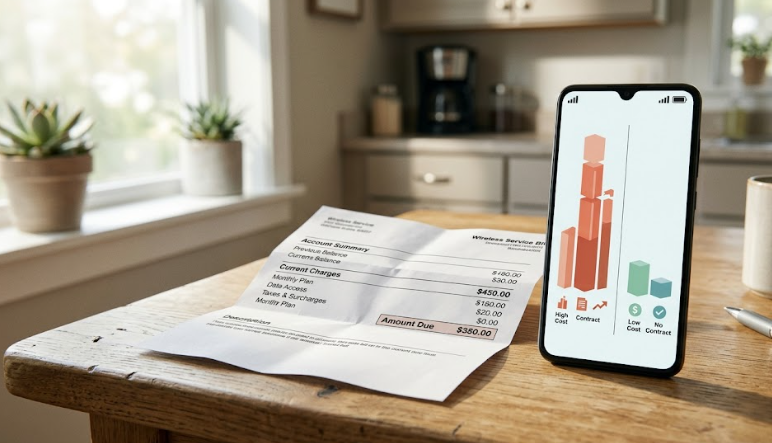
Your old phone plan usually does not feel expensive all at once.
It gets there slowly.
A discount expires. A newer plan looks better. A few dollars get added here and there. Then one day the bill shows up, and the question stops being theoretical.
Am I paying for a better setup, or am I just paying more because I stayed put?
That is why this AT&T price increase matters.
Starting in April 2026, AT&T says select retired unlimited wireless plans will cost $10 more per month for single-line accounts and $20 more per month total for multi-line accounts. As part of the change, affected plans also get an extra 20GB of hotspot data per month.
That sounds simple on paper. It is not.
Because this is not really just a story about AT&T raising prices. It is a story about whether your old plan still fits the way you actually use your phone.
For some people, staying put will still make sense.
For other people, this is the moment when loyalty quietly turns into overpaying.
Quick answer
If your AT&T plan just got more expensive, do not start by asking whether Visible is cheaper.
Start by asking whether you are still using your phone plan like a big-carrier customer.
If you rely on hotspot, have device payments tied to the account, use AT&T bundle discounts, or have a family setup that would be annoying to rebuild, staying may still be the smarter move.
But if your old bill already felt too heavy, your setup is simple, and you mostly want cheaper unlimited service without extra complexity, this is exactly the kind of moment when switching to Visible becomes hard to ignore.
What actually changed on AT&T
AT&T is not raising every wireless plan. It is specifically increasing prices on select retired unlimited plans.
The company says affected customers will see the change beginning in April 2026, and it frames the increase as part of continuing to provide reliable service. In return, impacted plans get an extra 20GB of hotspot data each month.
That is where people make an easy mistake.
They hear “more hotspot” and assume the increase got balanced out.
But extra value only matters if it is value you actually use.
If you were already barely touching hotspot, another 20GB is not compensation. It is just packaging.
And that is the trap with a lot of legacy plans. They survive because they feel familiar, not because they are still the best fit.
Why some people should stay with AT&T
This is the part cheap-plan articles usually skip.
There are still real reasons to stay.
One is hotspot usage. If you regularly tether a laptop, work on the go, or travel enough to notice the limit, the added 20GB may matter more than it first sounds.
Another is bundle math. AT&T says customers who bundle eligible unlimited wireless with AT&T Fiber or Internet Air can qualify for a 20% monthly discount. That means a “cheaper” move is not always as cheap as it looks when you isolate the wireless bill.
Then there is the annoying real-life stuff people forget to price in:
- phone installment balances
- locked devices
- multiple lines on one account
- family members who do not want to deal with porting
- a setup that already works and causes no drama
This matters because switching is not free just because the new monthly rate is lower.
Sometimes people chase the smaller bill and underestimate the friction.
If your current setup is stable, you actively use hotspot, and your total household discount picture is stronger than it first appears, staying can still be rational.
Why Visible is the obvious switch case right now
That said, Visible is the obvious comparison for a reason.
Visible currently offers three simple monthly plans: $25, $35, and $45, with taxes and fees included. It also offers a 15-day free trial.
That is why this is a real decision, not a fake blog comparison.
Visible is not just “some cheaper carrier.” It is cheap enough to make legacy AT&T customers stop and recalculate.
And when a price hike lands, people finally do the math they should have done months ago.
When switching to Visible makes the most sense
Visible looks strongest if most of this sounds like you:
- You are on a single line or a simple two-line setup.
- You were already questioning whether AT&T was worth the bill before the increase.
- You want predictable pricing more than store support or bundled extras.
- You do not use hotspot heavily enough for the extra 20GB to matter.
- You have an unlocked phone or are close to being able to unlock it.
- You are open to testing coverage before fully committing.
That last point matters.
Visible’s free trial is one of the smartest parts of the switch case. It gives cautious users a way to test whether cheaper service actually feels worse in daily life before blowing up a setup that mostly works.
That is a much better decision process than rage-switching the day a bigger AT&T bill shows up.
If you want another cheaper-carrier angle after this, read this next: Is Google Fi Worth It? Who Actually Saves by Switching.
When staying with AT&T still makes more sense
Visible is not automatically the answer if you are paying more.
Staying with AT&T still makes sense if:
- You use hotspot heavily enough that the extra 20GB is valuable.
- You have a phone payment or locked-device issue that makes switching messy.
- Your account is part of a household setup that would be painful to rebuild.
- Your bundle discounts soften the real damage.
- You have already tested cheaper carriers in your area and coverage was worse where you live or work.
This is where most simplistic advice goes wrong.
It assumes lower sticker price always wins.
It does not.
The right plan is not the cheapest plan in America. It is the cheapest plan that still fits the way you actually use your phone.
The switching costs people forget
When people talk about switching carriers, they talk about monthly price.
They usually ignore the transition cost.
That is where bad decisions hide.
Before you leave AT&T, check these first:
- Do you still owe money on your phone?
- Is your device unlocked?
- Will you lose any bundle discount on internet or other services?
- Does everyone on the account actually want to move?
- Are you switching because the bill got worse, or because a cheaper plan honestly fits you better now?
Those are not side questions. They are the whole decision.
A move that saves money on paper can still be a bad move if it creates friction you are not willing to manage.
The simple math that matters
The AT&T increase by itself does not automatically mean you should leave.
A single-line $10 increase is annoying, but it is not enough on its own to justify a messy switch if the rest of your setup still fits. A multi-line $20 increase total is also more complicated than it sounds because the pain gets spread across the account.
But that is not really the right calculation.
The better question is this:
If I were choosing from scratch today, would I still pick this old AT&T plan at its new price?
That question cuts through a lot of emotional loyalty.
Because if the honest answer is no, then the plan is probably surviving on inertia.
And inertia is expensive.
What I would do before making the move
I would not switch the same day the bill jumps.
I would do three things first.
First, I would check whether the account is getting enough real value from hotspot, bundle discounts, and any device financing to justify staying.
Second, I would test the cheaper option before fully committing. That is exactly what Visible’s free trial is good for.
Third, I would separate I hate this bill from I genuinely need a different kind of plan.
Those are not the same problem.
Sometimes people need a cheaper carrier.
Sometimes they just need to stop paying big-carrier prices for old habits they no longer have.
Bottom line
AT&T’s legacy unlimited plan price increase is the kind of moment that exposes lazy phone-plan decisions.
Not because AT&T suddenly became terrible.
But because the bill changed, and now you have to decide whether the old setup still earns its place.
If you rely on hotspot, use bundle discounts, or would create a giant family-account headache by moving, staying may still be the right call.
If your plan was already feeling too expensive, your needs are fairly simple, and you mostly want a cheaper unlimited option without contracts, Visible is the most obvious place to look first.
If I were making this decision, I would not ask which carrier sounds better.
I would ask one simpler question:
Am I paying for features I actually use, or am I just paying extra because I never got around to leaving?
That is usually where the real answer shows up.