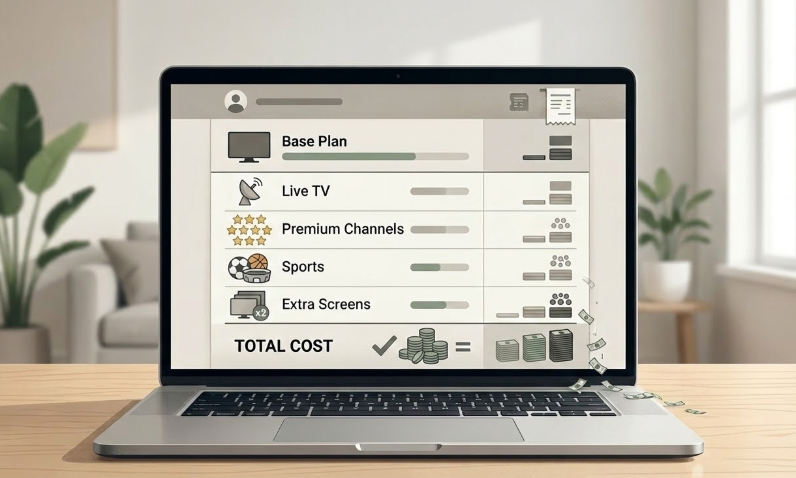
Hulu says there are no hidden costs.
That is technically true in the usual “no contract, no surprise penalty” sense.
But that does not mean your Hulu bill always stays as small as the advertised starting price.
This is where people get caught.
The base price looks simple. Then the real monthly cost quietly grows through upgrades, bundle changes, Live TV add-ons, premium channels, and tax.
So the real question is not “Does Hulu have hidden fees?” It is “What extra costs can make my Hulu bill bigger than I expected?”
The starting price is not always the real price
At first glance, Hulu looks straightforward.
- Hulu (With Ads): $11.99 per month
- Hulu (No Ads): $18.99 per month
- Disney+, Hulu Bundle: $12.99 per month with Hulu (With Ads)
- Disney+, Hulu Bundle: $19.99 per month with Hulu (No Ads)
- Hulu + Live TV: $89.99 per month
The problem is not the sticker price itself.
The problem is how quickly a “small monthly subscription” turns into a noticeably larger bill once extra layers get added.
The easiest extra cost to miss: the No Ads upgrade
This is the cleanest example.
Going from Hulu (With Ads) to Hulu (No Ads) adds $7 per month.
That sounds manageable until you annualize it.
Over a year, that is $84 more.
That does not automatically mean it is a bad choice. But it does mean the upgrade should be treated like a real spending decision, not a comfort click you never revisit.
If this is the part you are stuck on, read this next: Hulu With Ads vs No Ads.
The bundle can make Hulu feel cheaper than it really is
The Disney+, Hulu Bundle is one of the easiest places to lose track of what you are paying for.
The price difference between standalone Hulu and the bundle can look small enough to feel harmless.
That is exactly why it works.
If Disney+ becomes background value instead of real value, the bundle stops being a deal and starts becoming a soft monthly leak.
This is not a “fee” in the penalty sense. It is a cost expansion you may stop noticing because the upgrade looked too small to matter.
If that is your situation, use this: Disney Bundle vs Standalone Hulu.
Live TV is where Hulu stops being a light subscription
A lot of people say “I pay for Hulu” when what they really mean is “I pay for Hulu + Live TV.”
That is a completely different kind of bill.
Once Live TV enters the picture, you are no longer dealing with a light streaming cost. You are much closer to an old cable-style bill.
And this is where add-ons start stacking fast.
The add-ons that quietly grow the bill
If you have Hulu + Live TV, there are several ways the bill can grow beyond the headline plan price.
- Unlimited Screens Add-on: $9.99 per month
- Sports Add-on: $9.99 per month
- Cinemax add-on: $9.99 per month
- ESPN Select: $12.99 per month
And that is before other premium channel or partner add-ons.
This is how Hulu starts looking less like one subscription and more like a platform you keep customizing upward.
None of these costs are truly hidden. They are optional. But they become “hidden” in real life when you stop remembering what you added and why it is still there.
As with most streaming add-ons, pricing can change over time, so it is worth checking your current Hulu billing page before assuming an older add-on price is still current.
Tax is another reason the real bill may look higher
Hulu also says it may charge sales tax based on your billing address in order to comply with state and local laws.
That means the number you see advertised is not always the exact number that lands on your statement.
So even if you never add a premium feature, your real monthly charge may still come in a little higher than the headline price.
The real hidden fee is not always a fee
This is the part most people miss.
The biggest Hulu leak is often not a penalty, a late fee, or some secret charge.
It is the accumulation of small “sure, why not” upgrades that were never actively re-decided.
- You add No Ads because ads are annoying.
- You add a bundle because it is only a little more.
- You add Live TV because it feels easier than comparing alternatives.
- You add channels or features because they sound useful at the time.
Individually, each step can feel reasonable.
Together, they can turn Hulu from a manageable streamer into a subscription stack you barely evaluate anymore.
A fast audit to check your real Hulu cost
If you want a quick answer, do this:
- Open your most recent Hulu charge.
- Write down your base plan.
- List every add-on, upgrade, or bundle tied to it.
- Check whether tax is included in the final charge.
- Ask whether each extra cost still has a real job.
If you cannot explain why something is there, that is the first thing to question.
Bottom line
Hulu does not work like a sneaky bank fee account.
Its extra costs are usually visible.
But visible is not the same as noticed.
The real danger is that Hulu can start at one advertised price and slowly become a much bigger monthly bill through plan upgrades, bundles, Live TV, add-ons, and tax.
The clean question is simple:
Am I paying for Hulu, or for a version of Hulu that quietly grew beyond what I meant to keep?
Still deciding whether Hulu itself should stay? Read Should I Cancel Hulu?