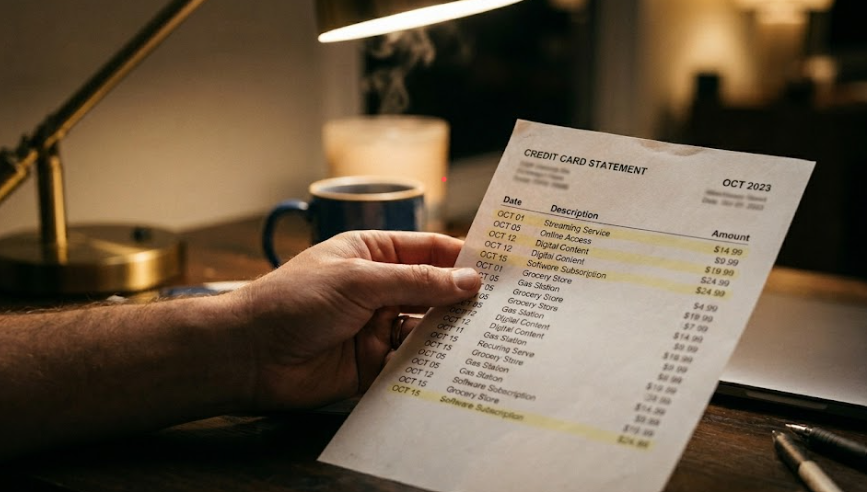
The kind of wasted money this site focuses on rarely comes from one obviously bad decision. It comes from old decisions that keep renewing after your life has changed.
Open your last credit card statement and look at the charges that barely make you react anymore.
Not the giant bill. Not the emergency expense. The quiet ones.
A streaming plan you barely open. A cloud storage upgrade that felt necessary two phones ago. A membership you started during a busy month and never went back to question. A mobile plan that made sense when your life looked different.
Each one is small enough to ignore for another month. That is exactly how it stays there for the next fourteen.
This is how money tends to disappear in real life. Not through one obviously terrible decision, but through a reasonable decision that quietly stopped being reviewed.
The frustrating part is that many of these charges were not stupid when they started. You probably had a reason. You wanted one show. You needed more storage. You signed up for faster delivery. You chose the plan that felt safest at the time.
Then life changed. The charge didn’t.
Not a reckless decision.
An unchecked one.
People rarely sit down and actively decide to keep paying for something that no longer fits. They just stop noticing the decision is being made at all. What was once intentional turns into routine. What was once practical becomes background noise. And once a charge feels normal, it stops feeling like spending. It feels like part of life.
That’s the pattern this site is built around.
Is It Still Worth It? focuses on recurring decisions. Subscriptions, memberships, mobile plans, software, bundles, delivery services, storage upgrades, and anything else that keeps charging you after the original decision has faded from memory.
The goal isn’t to talk you into canceling everything. That’s too simple, and usually not realistic. The goal is to make each quiet charge visible again, so it gets judged against your life now instead of the version of your life that existed when you signed up.
A phone plan picked four years ago.
A subscription that fit a job you no longer have.
A streaming service kept for one show that ended last season.
A starter plan that quietly became the regular plan.
None of those choices had to be wrong at the time. They just needed a second look later. That second look is the part that quietly gets skipped.
That’s why the leaks are so easy to miss. They don’t arrive as one painful event. They build through small renewals that never got questioned at the right time.
What you’ll find here
Every post on this site is built around one practical question: does this still deserve a place on your bill?
- Keep or cancel reviews for subscriptions and memberships that quietly stay on the bill.
- Switch or downgrade comparisons when something cheaper covers the same real use.
- Hidden cost breakdowns when the headline price does not tell the whole story.
- Direct comparisons when you’re stuck between two realistic options.
This is not a site about canceling everything. Some things are worth keeping. Some are worth downgrading. Some are worth switching. Some are worth pausing until you actually need them again.
The mistake is not paying for something useful. The mistake is letting an old decision keep renewing after the reason for it has disappeared.
How a decision gets reviewed here
The standard is simple. Use, price, alternatives, switching friction, and whether the benefit you actually use is still big enough to justify what you pay.
Sometimes the answer is to keep it. Sometimes the smarter move is not full cancellation, but a lower tier, a bundle change, or a clean switch to something that fits better. Sometimes pausing is enough until the next season of life decides for you.
The point is not to chase the cheapest possible life. The point is to stop paying by default after the original reason is gone.
Good decision then.
Life changes.
No review happens.
The charge keeps going.
That loop explains why monthly waste can be hard to see. It shows up in streaming, grocery memberships, software, cloud storage, internet bundles, mobile plans, and any service you once needed but no longer use the same way.
Which leads to the question this whole site keeps coming back to:
If this charge appeared on your statement today for the first time, would you sign up for it now?
If your honest answer is no, probably not, or not sure, that hesitation is worth paying attention to. The charge may not need to disappear today, but the decision deserves a real review.
Try this in 60 seconds:
Open your banking app, card app, or subscription list. Pick one recurring charge. Just one.
If the answer were yes, would it come quickly, or would you have to talk yourself into it?
If you have to argue yourself into keeping it, that hesitation is useful. You don’t have to cancel today, but the charge deserves a real review.
That’s one charge. A full statement often has more.
The free Subscription Decision Worksheet runs the same question across every recurring line on your bill. A 10-minute check, sent to your inbox.
No filler emails. Unsubscribe whenever.
Where to start
Don’t try to review everything at once. That’s how reviews stall before they start. Pick the single charge that feels most overdue for a second look, and begin there.
- Am I Overpaying for Subscriptions? A Simple Monthly Check: the fastest practical review to run this week.
- A Real Subscription Audit: 5 Questions Before You Keep Paying: the process of pulling every recurring charge into one view.
From there, you can move into a keep or cancel decision, a direct comparison, a hidden cost check, or a search for a better alternative. It depends entirely on which bill you’re starting to question.
Why this site exists
The kind of wasted money this site is built to catch rarely looks like a mistake. It looks normal, familiar, and easy to keep paying for one more month. That’s exactly why it adds up.
This site exists to make those decisions visible again, so each charge gets judged on its own merit instead of rolling forward by habit.