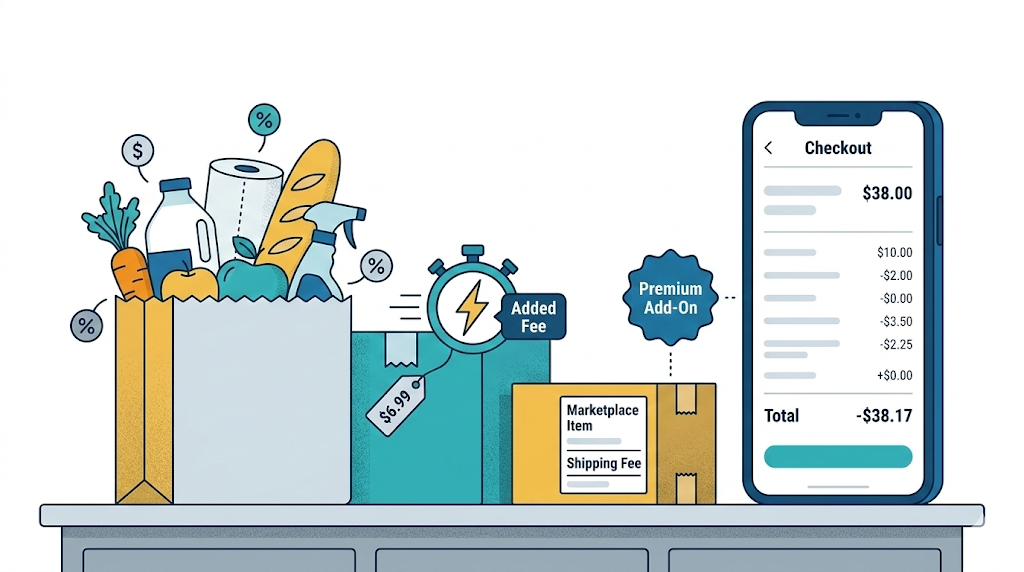
Quick Answer: Walmart+ doesn’t make every order free. The main extra costs to check are the $6.99 minimum order fee on store delivery orders under $35, Express delivery fees, marketplace shipping charges, oversized item surcharges, the InHome add-on, and paid streaming upgrades. Walmart+ is easier to justify when your normal orders already clear the rules without forcing extra spending.
Walmart+ sounds simple from the outside.
Pay one membership fee, get free delivery, free shipping, and a few extra perks.
But that’s where the math gets sloppy. Walmart+ can still cost more than expected when your order pattern doesn’t match the rules.
If you mostly place solid grocery or household orders over $35, Walmart+ can still be a strong value.
If you keep placing small orders, choosing faster delivery, or assuming every item is covered the same way, the “free” part gets thinner fast.
The rule that changes the math
Walmart+ doesn’t automatically make every order free.
It works when your orders naturally fit Walmart’s delivery and shipping rules. Once they don’t, extra costs start showing up in small, easy-to-ignore ways.
That’s why the same membership can feel like a clear win for one shopping pattern and a quiet leak for another.
The extra costs that catch people off guard
1. The under $35 minimum order fee
This is the first fee to check.
Walmart says free delivery from store has a $35 order minimum. If your order doesn’t reach that amount, Walmart says you can be charged a $6.99 minimum order fee.
If you keep making small convenience orders, you can end up paying for Walmart+ and still paying extra because your order pattern doesn’t fit the membership rules.
2. Express delivery fees
Faster isn’t the same as free.
Walmart’s fee schedule says Express delivery carries a $10 Express fee. Walmart+ members usually avoid the standard delivery fee on eligible $35+ orders, but the Express fee still applies.
So if you regularly need items faster than the normal delivery window, Walmart+ may still cost more than it first appears.
3. Marketplace shipping charges
Not every item is covered the same way.
Walmart says free shipping with no order minimum applies to items sold by Walmart or shipped by Walmart. Marketplace items can have separate shipping charges, even though they may still count toward the $35 minimum for free shipping from Walmart.
This is an easy way to think you’re getting “free shipping” and still see extra cost at checkout.
4. Freight and oversized item surcharges
Big items can break the illusion fast.
Walmart’s fee schedule says freight and oversized items can carry separate surcharges, even for Walmart+ members.
If your order includes furniture, bulky household items, or other oversized products, don’t assume the membership wipes out every shipping cost.
5. Certain categories don’t count the way you expect
Walmart’s fee schedule says some categories, including pharmacy, photo, wireless, and tires, don’t count toward the $35 minimum amount and don’t ship free in the normal way.
If you assumed every item in your cart helped you clear the threshold, this is the kind of detail that can throw off the math.
6. Location-based fees
Some extra charges depend on where you live.
Walmart’s fee schedule says certain states and municipalities may charge bag fees, and notes location-based charges such as Colorado’s retail delivery fee, which can change by year. Shipping to Hawaii, Alaska, U.S. territories, or overseas locations can also involve added shipping fees.
These aren’t massive amounts on their own, but they matter if you’re judging Walmart+ as a “fully covered” service.
7. InHome costs extra
InHome can look like part of Walmart+ if you’re scanning the perk list quickly.
It’s not. Walmart says InHome is a separate add-on, priced at $7 per month or $40 per year for Walmart+ members, plus tax.
If you’re keeping Walmart+ mainly because you might try InHome later, that’s a weak reason. Treat it as a separate decision with a separate cost.
8. Premium streaming upgrades cost extra
Walmart+ includes a choice between Paramount+ Essential and Peacock Premium with ads. That part is included.
But Walmart’s terms also say members can upgrade to Paramount+ Premium for an additional fee billed through Walmart. The “free streaming” story can get more expensive if you want the higher tier.
When these extra costs actually matter
These costs matter more if your pattern looks like this:
- You place lots of small orders instead of real stock-up orders.
- You choose speed over planning and keep using Express delivery.
- You buy a mix of Walmart and marketplace items without checking how they ship.
- You assume all perks are included, even when they’re actually upgrades or add-ons.
If that sounds like you, the issue isn’t that Walmart+ is “bad.” The issue is that your order behavior doesn’t fit the membership’s core use case.
When Walmart+ still makes sense anyway
Walmart+ can still be worth it if:
- You place regular grocery or household orders that naturally clear $35.
- You use standard delivery more than Express delivery.
- You buy mostly items sold or shipped by Walmart.
- You actually use the included benefits without upgrading every extra tier.
In other words, Walmart+ fits routine shoppers better than last-minute backup convenience.
A quick way to check your own extra costs
- Open your last 3 Walmart orders.
- Look for any order under $35.
- Look for any Express fee, shipping charge, or separate item surcharge.
- Ask one question: am I paying for Walmart+ and still paying extra often enough that the membership math is getting weaker?
If the answer is yes, the right move may not be “use it more.” It may be to treat the membership for what it actually is. Useful for some patterns, expensive for others.
Run a 10-minute subscription check before you cancel the wrong one.
If Walmart+ is only one of several memberships with extra rules, the worksheet helps you decide which one to keep, pause, or cancel first.
No filler emails. Unsubscribe whenever.
Bottom Line
Walmart+ hidden fees aren’t really hidden if you read the rules, but they’re easy to miss when you assume the membership makes every order cheaper. The membership is easier to justify for routine $35+ grocery and household orders than for small top-up orders, Express delivery, marketplace-heavy carts, or paid add-ons you rarely use.
Keep Walmart+ if your normal orders clear $35, you use standard delivery, and extra costs rarely show up at checkout.
Recheck or pause if your fees come from temporary behavior, like a busy month or a few Express orders, and you want a softer test before committing to cancel.
Cancel if small-order fees, Express fees, marketplace shipping, InHome charges, or paid streaming upgrades are doing more of the work than the base membership.
FAQ
Does Walmart+ really have hidden fees?
Not exactly. Walmart’s help center discloses these costs, but it’s easy to miss how often they show up, especially on small orders, Express delivery, marketplace items, or oversized items.
What is the Walmart+ minimum order fee?
Walmart says free delivery from store uses a $35 minimum, and if you don’t meet it, you may be charged a $6.99 minimum order fee.
Does Walmart+ cover Express delivery?
Not fully. Walmart’s fee schedule says the standard delivery fee is waived for members on eligible $35+ orders, but the $10 Express fee still applies.
Does Walmart+ include InHome?
No. Walmart says InHome is a separate add-on for Walmart+ members at $7 per month or $40 per year, plus tax.
Do marketplace items ship free with Walmart+?
Not always. Walmart says free shipping with no order minimum applies to items sold by Walmart or shipped by Walmart. Marketplace items may have separate shipping charges.