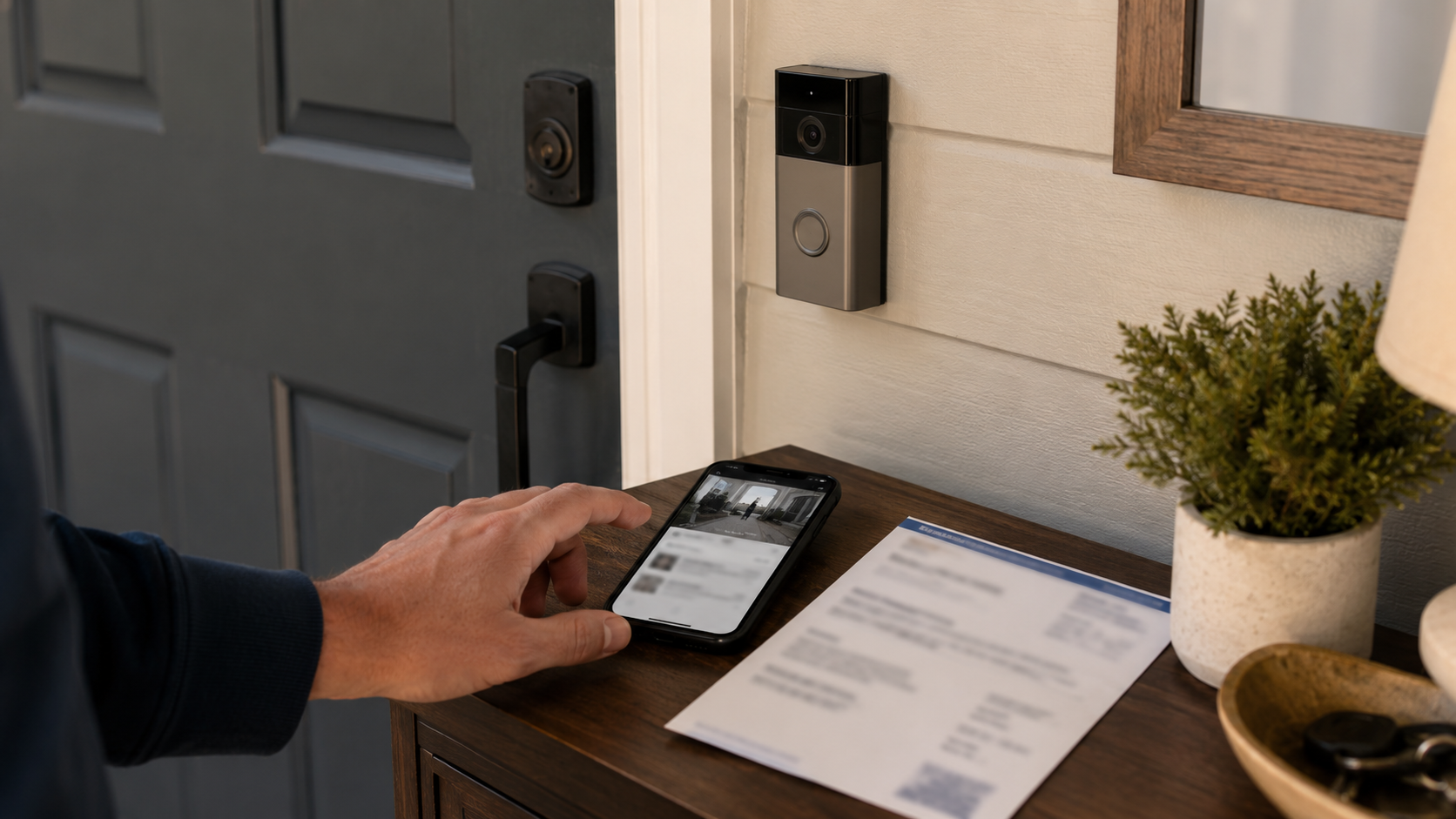
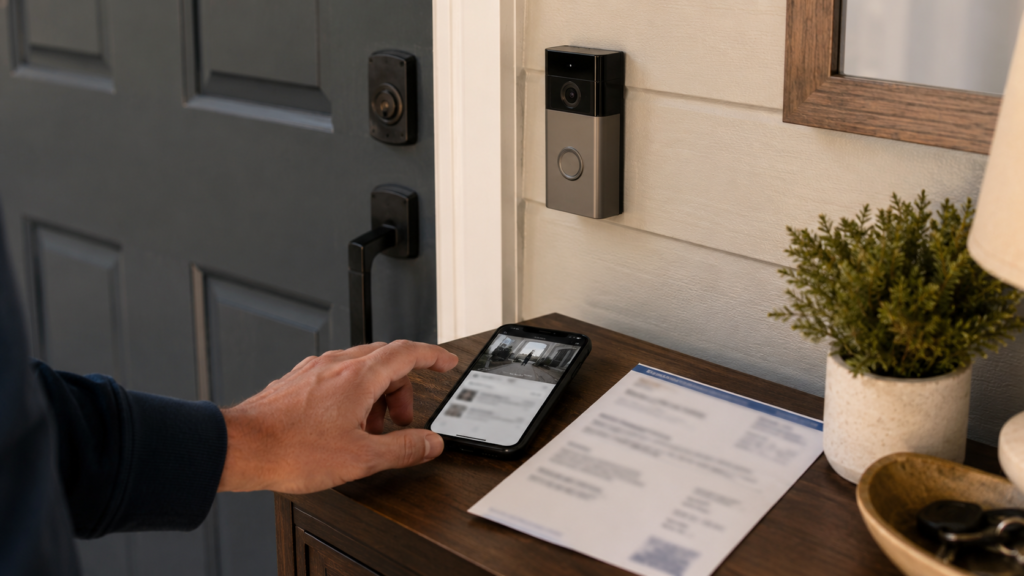
Quick Answer: A Ring doorbell or camera keeps working without a subscription. Live View, motion alerts, and two-way talk stay free, and the doorbell still rings. What disappears is every recording: without a plan, Ring saves nothing, so there is no clip to replay after a missed delivery or a 2 a.m. alert. If reviewing footage matters to you, the $4.99-a-month Solo plan is effectively part of the camera’s purchase price.
Ring answers this question itself, in smaller print than the checkout button. The official Ring Protect plans page confirms that devices “provide certain features without a plan,” and that video recording sits on the paid side of the line. As of July 2026, plans run from Solo at $4.99 a month to Pro at $19.99. So the real question is not whether the camera works without paying. It does. The question is whether the version that works is the product you thought you were buying.
What works without paying, and what locks
The free tier is more usable than Ring’s marketing suggests. Open the app and Live View streams in real time. Someone approaches the door, a motion alert lands on your phone. Press the speaker icon and you are talking to the delivery driver. You can adjust motion zones, tune sensitivity, check battery and Wi-Fi health, and control the device from the app. None of that expires.
The paid tier is everything built on saved video, plus a few things Ring has decided belong there.
| Free without a plan | Requires a Ring Protect plan |
|---|---|
| Live View on demand | Video event history, up to 180 days |
| Motion alerts (generic motion) | Smart alerts for people, packages, vehicles |
| Two-way talk | Extended Live View, up to 30 minutes |
| Doorbell ring and chime | Snapshots and saved clips to share or download |
| Motion zones and sensitivity settings | Home and Away modes in the app |
| Device health and app control | Extended warranty (Multi and up), professional monitoring (Pro with Ring Alarm) |
The catch: nothing is saved, not even for an hour
Ring offers no free video history at all. Not a rolling 24 hours, not the last three events, not a single thumbnail. The one exception proves the rule: Ring Edge can store video locally on a microSD card, but it requires a Ring Alarm Pro Base Station and a compatible Ring subscription. Even Ring’s local storage path still runs through a paid plan. So if the camera catches something and you were not watching the live feed at that exact moment, the footage does not exist.
That design choice defines who can skip the plan. A security camera earns its keep in the moments you were not looking: the package that vanished at 2:14 p.m., the car that clipped your mailbox, the stranger who tried the door handle overnight. Without a plan, a Ring camera can tell you something happened. It cannot show you what.
The 30-day free trial that starts at setup makes this easy to misjudge. During the trial, every recording is there, replayable, shareable. Then the trial lapses and the app quietly reverts. The camera did not get worse. It is showing you, for the first time, what the free tier actually was.
One detail turns the trial from a sample into a countdown: Ring’s trial information page states that recorded videos are deleted immediately when the trial ends, unless you subscribe first. The same rule applies to a paid plan you cancel later. So the order matters: download the clips you care about first, then let the plan end. Not the other way around.
The free feature list is a policy, not a spec sheet
Features that came with the camera stay with the camera. On a cloud camera, the feature list is whatever the company says it is this year. In March 2023, Ring moved Home and Away modes, which had been free, behind the subscription for doorbell and camera owners, and coverage at the time noted that new Ring Alarm users also lost free app-based arming and disarming. Owners who bought hardware under one set of rules woke up to another.
This matters for the skip-the-plan decision in a specific way. The free tier listed above is accurate as of July 2026, and it is genuinely useful. It is also not a contract. If your plan is to run Ring free forever, you are betting that a company which has already narrowed the free tier once will not do it again. That is not a reason to panic. It is a reason to treat the hardware price, not the hardware plus its current free features, as what you are actually buying.
Who can honestly skip the plan
Skipping is a legitimate choice for a narrower group than the refund-seeking forum threads suggest. It works when the camera is a convenience, not a witness.
You can skip the plan if the device is a smart intercom to you: someone rings, you look, you answer, done. It also holds if someone is home during the day and the doorbell mainly saves them a trip to the door, or if another system already records your property and Ring is just the chime with a view. In those cases the free tier covers the entire job, and $49.99 a year buys you nothing you would open twice.
The math flips the moment you want evidence. Package theft claims, an insurance dispute, a report to the police, checking what set off the alert while you were on a flight: all of it depends on a recording the free tier does not keep. That frustration shows up in Ring’s Trustpilot reviews too, where buyers describe a device that stops doing what they bought it for once the trial ends. The hardware did not fail them. The assumption did.
One more honest check before you decide. If the urge to cancel comes from notification fatigue rather than the fee, adjust motion zones and sensitivity first. A camera that pings for every passing car is a settings problem, and no plan change fixes that.
If you decide to pay, match the plan to the device count
The plan decision is simpler than the three-tier menu implies. As of July 2026, Solo runs $4.99 a month or $49.99 a year and covers one device. Multi runs $9.99 a month or $99.99 a year and covers every Ring device at one address. Pro runs $19.99 a month or $199.99 a year and adds 24/7 professional monitoring for a compatible Ring Alarm plus AI features that apply only to eligible cameras, with some features unavailable in certain states.
One device, Solo. Two or more, Multi. Pro only if a Ring Alarm and emergency response are part of the picture, not because it sounds safer. The full breakdown, including where the break-even sits when you add a second camera, is in Ring Solo vs Multi vs Pro: Which Plan Fits Your Home?
The cleanest test is not how often Ring notifies you. It is how often you would regret missing the replay. If that regret is hard to picture, the free tier can carry the job. If it is easy to picture, the subscription is not really an upgrade. It is the part that makes the camera useful after the moment has passed.
Bottom Line
A Ring camera without a subscription is a live window, not a security record, and that single fact is what the decision comes down to.
Skip the plan if: you use Ring as a live intercom, you accept that nothing gets saved, and you cannot recall a moment you wanted to replay.
Keep Solo if: you have one device and there has been even one moment you wished you could replay.
Upgrade to Multi if: a second Ring device is on your porch or in your cart, since per-device Solo plans stop making sense at two.
Pay for Pro only if: a compatible Ring Alarm and professional monitoring are the reason, not the AI features alone.
Switch if: paying monthly to unlock recording on hardware you own feels wrong on principle. Cameras with local storage, such as eufy or TP-Link Tapo models, save footage to a card with no plan at all, and that is the honest comparison to run before buying more Ring hardware.